
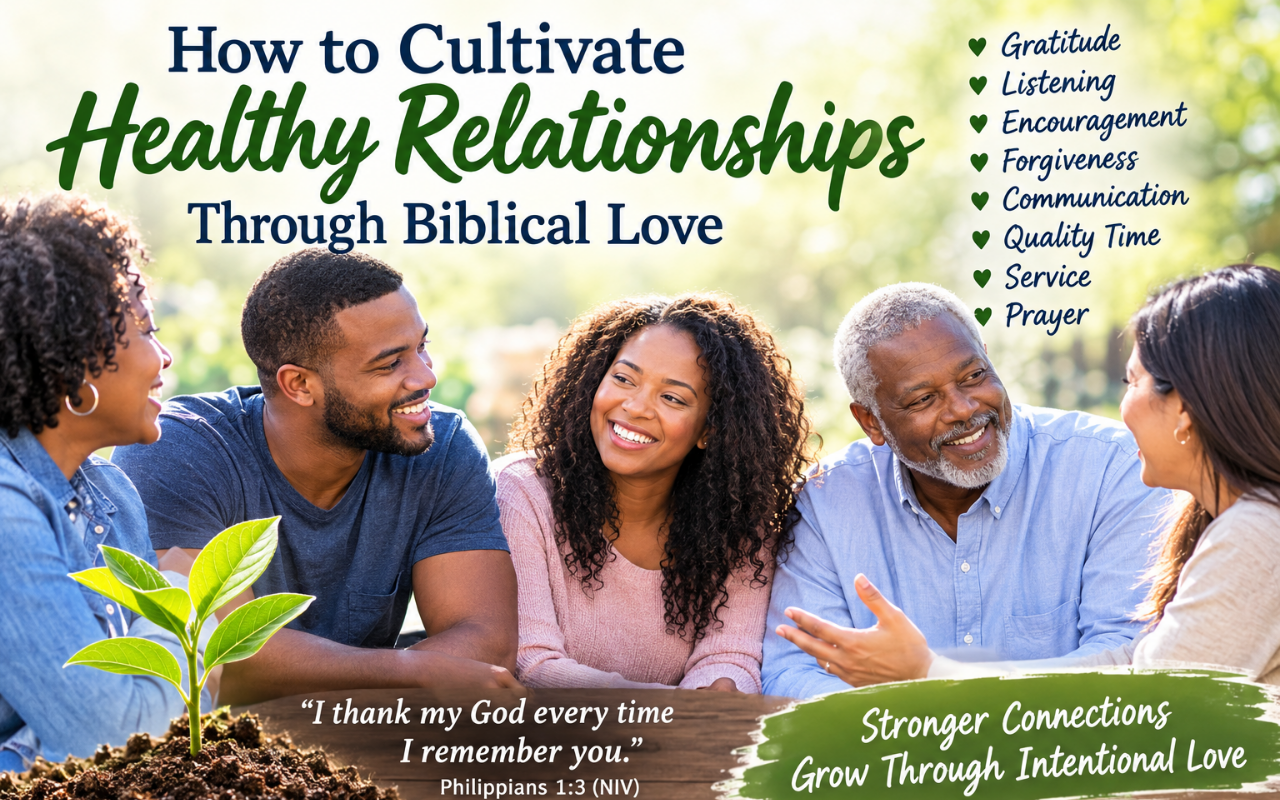
How to Cultivate Healthy Relationships: Biblical Principles for Stronger Connections
How to Cultivate Healthy Relationships
Have you ever looked at a relationship that once felt strong and wondered, “What happened?”
Perhaps the conversations became shorter. The encouragement disappeared. Small disagreements became major problems. Eventually, two people who once felt close began to feel like strangers.
However, healthy relationships rarely happen by accident.
They require attention, patience, humility, forgiveness, and love.
As a Christian writer and someone who values biblical truth, I have learned that relationships need the same kind of intentional care that we give to anything we want to grow. Therefore, today we will look at practical and biblical ways to cultivate healthy relationships, strengthen our connections, and become better friends, spouses, family members, coworkers, and members of our communities.
Most importantly, we will discover how following the example of the Lord Jesus Christ can change the way we relate to others.
Relationships Are Like Seeds
Imagine planting a seed.
You cannot put it in the ground and forget about it.
Instead, you must give it water. You must provide the right conditions for growth. You must remove weeds. You must protect it from things that could destroy it.
Eventually, that small seed can become something beautiful.
Relationships work in much the same way.
A friendship, marriage, family relationship, or Christian fellowship needs care. It needs communication. It needs trust. It needs forgiveness. Most importantly, it needs love.
If we neglect relationships for too long, distance can develop.
However, when we intentionally invest in people, relationships can grow stronger.
That is why building healthy relationships requires more than simply spending time together. We must learn how to care for one another.
Paul Showed Us the Power of Appreciation
The apostle Paul gives us a wonderful example of a healthy Christian relationship.
Paul wrote to the believers in Philippi:
“I thank my God upon every remembrance of you.”
— Philippians 1:3, KJV
The Philippian believers had supported Paul during his ministry. They demonstrated generosity, fellowship, and commitment to the work of the Gospel.
Even after Paul moved on to other places, their relationship continued.
Therefore, when Paul wrote to them, he did not focus only on his difficulties.
Instead, he remembered them with gratitude.
That lesson remains powerful today.
When someone has encouraged you, supported you, prayed for you, helped you, or simply stood beside you during a difficult season, tell them that you appreciate them.
Do not assume they already know.
Sometimes, a simple “thank you” can strengthen a relationship more than we realize.
1. Practice Genuine Gratitude
First, cultivate healthy relationships by practicing gratitude.
People want to know that their efforts matter.
Your spouse may appreciate hearing that you noticed something they did.
Your friend may need to know that their encouragement helped you.
A family member may need to hear that you appreciate their support.
Therefore, do not allow appreciation to remain unspoken.
Send a message.
Make a phone call.
Write a note.
Give someone a sincere compliment.
Most importantly, let people know that you value them.
Gratitude changes the atmosphere of relationships because it shifts our attention from what people fail to do toward what they faithfully contribute.
2. Learn to Listen
Next, learn to listen.
Many relationship problems begin because people listen only long enough to prepare their response.
They hear the words, but they do not hear the heart.
Healthy communication requires something different.
It requires attention.
When someone speaks to you, put down the phone when possible. Make eye contact. Avoid interrupting. Ask questions. Give the person an opportunity to explain what they really mean.
Sometimes people do not need you to solve their problem.
They simply need someone who will listen.
For example, imagine a friend telling you about a difficult day at work.
You could immediately say, “You should do this.”
Instead, you might say, “That sounds difficult. Tell me what happened.”
That small difference can make someone feel heard and valued.
Therefore, healthy communication begins with genuine listening.
3. Encourage People
Furthermore, learn to encourage others.
Life can become difficult.
People face financial pressure, family problems, disappointment, loneliness, uncertainty, and fear.
Sometimes, one encouraging word can help someone continue moving forward.
The Bible reminds us:
“Wherefore comfort yourselves together, and edify one another, even as also ye do.”
— 1 Thessalonians 5:11, KJV
The word edify means to build up.
Therefore, ask yourself:
Am I building people up or constantly tearing them down?
Your words have power.
A sincere compliment can build confidence.
A word of hope can strengthen someone who feels discouraged.
A prayer can remind someone that they are not alone.
A simple phone call can reconnect two people who have grown distant.
Consequently, if you want stronger Christian relationships, become someone who intentionally encourages others.
4. Practice Forgiveness
Next, healthy relationships require forgiveness.
This does not mean pretending that harmful behavior never happened.
It does not mean ignoring serious wrongdoing.
Instead, biblical forgiveness means refusing to allow bitterness and resentment to control your heart.
The Lord Jesus Christ taught us the importance of forgiveness because He wants us to understand the power of mercy.
Sometimes relationships become unhealthy because people keep reopening old wounds.
Someone apologized years ago, but the offense continues to appear in every argument.
Someone made a mistake, and we continue defining them by that mistake.
However, healthy relationships need room for repentance, growth, and restoration.
Therefore, when forgiveness is appropriate and safe, choose forgiveness over bitterness.
At the same time, remember that forgiveness does not always mean restoring the same level of trust immediately. Trust may need to be rebuilt through consistent actions over time.
5. Communicate Honestly and Respectfully
Additionally, healthy relationships need honest communication.
Avoiding every difficult conversation does not create peace.
Sometimes, it only creates hidden resentment.
However, honesty without kindness can also damage relationships.
Therefore, speak the truth with love.
If something bothers you, explain it respectfully.
Instead of saying:
“You never listen to me.”
Try saying:
“I felt unheard when I was speaking earlier. Could we talk about it?”
The second statement addresses the problem without attacking the person’s character.
That approach creates an opportunity for conversation rather than conflict.
Consequently, healthy communication combines honesty, respect, patience, and love.
6. Make Time for the People You Love
Moreover, relationships need time.
You can tell someone that you love them, but your actions should support your words.
Make time for the people who matter.
Have dinner together.
Take a walk.
Call a friend.
Visit a family member.
Pray together.
Share a conversation without constantly checking your phone.
Small moments often become the memories we treasure most.
Think about your closest relationships.
When was the last time you intentionally spent quality time with someone you care about?
If you cannot remember, perhaps it is time to reconnect.
7. Serve Others
Another powerful way to cultivate healthy relationships is through service.
Love becomes visible through action.
You can serve someone by helping with a task.
You can bring someone a meal.
You can offer transportation.
You can pray for someone.
You can volunteer together.
You can simply show up when someone needs encouragement.
The Lord Jesus Christ demonstrated servant leadership throughout His earthly ministry.
Therefore, Christian relationships should not revolve only around what we can receive.
They should also involve what we can give.
Ask yourself:
“How can I make someone else’s life a little better today?”
That question can transform your relationships.
8. Pray for the People in Your Life
Finally, pray for the people around you.
Paul demonstrated this beautifully.
When he remembered the Philippian believers, he responded with thanksgiving and prayer.
Likewise, we can bring our relationships before the Lord Jesus Christ.
Pray for your spouse.
Pray for your children.
Pray for your parents.
Pray for your friends.
Pray for your coworkers.
Pray even for people with whom you have difficult relationships.
Prayer can change our perspective.
Instead of constantly focusing on someone’s weaknesses, we begin asking how we can love, encourage, and serve them.
What About Difficult Relationships?
Of course, not every relationship will become healthy simply because you try harder.
Some relationships involve manipulation, repeated dishonesty, abuse, or destructive behavior.
Therefore, wisdom matters.
Healthy relationships require boundaries as well as love.
You can forgive someone while maintaining appropriate boundaries.
You can love someone without allowing them to continually mistreat you.
You can pray for someone without giving them unlimited access to your life.
Consequently, cultivating healthy relationships does not mean becoming a person without boundaries.
Instead, it means learning to combine love, wisdom, grace, truth, and healthy boundaries.
A Simple Relationship Challenge
Today, choose three people.
First, think about someone who has helped you.
Second, think about someone who needs encouragement.
Third, think about someone with whom your relationship needs attention.
Then take one action.
Send the first person a thank-you message.
Encourage the second person.
Start a respectful conversation with the third.
You do not have to repair every relationship in one day.
However, one intentional action can begin a meaningful change.
Interactive Christian Relationship Quiz
How Healthy Are Your Relationships?
Answer Yes or No to each question.
- Do you regularly express gratitude to the people in your life?
- Do you listen without constantly interrupting?
- Do you encourage others when they are discouraged?
- Can you apologize when you are wrong?
- Can you forgive when someone sincerely repents?
- Do you make intentional time for important relationships?
- Do your words build people up?
- Do you respect healthy boundaries?
- Do you pray for the people around you?
- Do your actions demonstrate the love you say you have?
Your Reflection
If you answered Yes to most questions, keep strengthening those habits.
If you answered No to several questions, do not become discouraged.
Instead, identify one area that needs improvement and begin there.
Healthy relationships grow through consistent choices.
Quick Poll
Which area of relationships do you think needs the most attention today?
- ❤️ Showing appreciation
- 👂 Listening
- 💬 Communication
- 🙏 Forgiveness
- 🤝 Spending quality time
- 🌱 Setting healthy boundaries
Share your answer and explain why.
Your response may encourage someone else who is facing the same challenge.
The Most Important Relationship
Above all, we must remember that our relationship with the Lord Jesus Christ should influence every other relationship.
When we allow His love to shape our hearts, we can become more patient.
We can become more forgiving.
We can become better listeners.
We can become more compassionate.
We can learn to serve rather than always demand to be served.
The Lord Jesus Christ said:
“This is my commandment, That ye love one another, as I have loved you.”
— John 15:12, KJV
That command reaches beyond romantic relationships.
It includes friendships.
It includes families.
It includes Christian fellowship.
It includes our communities.
Therefore, Christ-centered relationships begin when we allow the love of the Lord Jesus Christ to influence the way we treat people.
Start Planting Today
Remember the seed we talked about at the beginning?
A seed does not become a healthy plant overnight.
Growth takes time.
Relationships work the same way.
You may not be able to fix everything today.
You may not be able to change another person’s behavior.
However, you can control how you respond.
You can listen.
You can encourage.
You can forgive.
You can communicate honestly.
You can show appreciation.
You can serve.
You can pray.
Most importantly, you can choose to love people intentionally.
So today, do not simply think about the people who have supported you.
Thank them.
Do not simply think about someone who needs encouragement.
Encourage them.
Do not simply say that relationships matter.
Invest in them.
Because just like a seed, a relationship will grow when you consistently give it the care, attention, patience, and love it needs.
And as we follow the example of the Lord Jesus Christ, we can cultivate healthy relationships that bring encouragement, strength, and lasting spiritual growth.
Who can you encourage today?
Subscribe to our YouTube channel for more inspiring biblical encouragement and faith-filled content:
Possibility Plus:
https://www.youtube.com/@PossibilityPluspm
Support our ministry and help us continue sharing hope, truth, and the message of the lord Jesus Christ:
https://printify.com/app/store/products/1
Get your copy of Deceived No More: Wolves in Sheep’s Clothing by Paul Edwards:
https://www.amazon.com/Deceived-No-More-Wolves-Clothing/dp/B0FVFFVYYB
Keep walking. Keep trusting. Keep in step with the Spirit.