
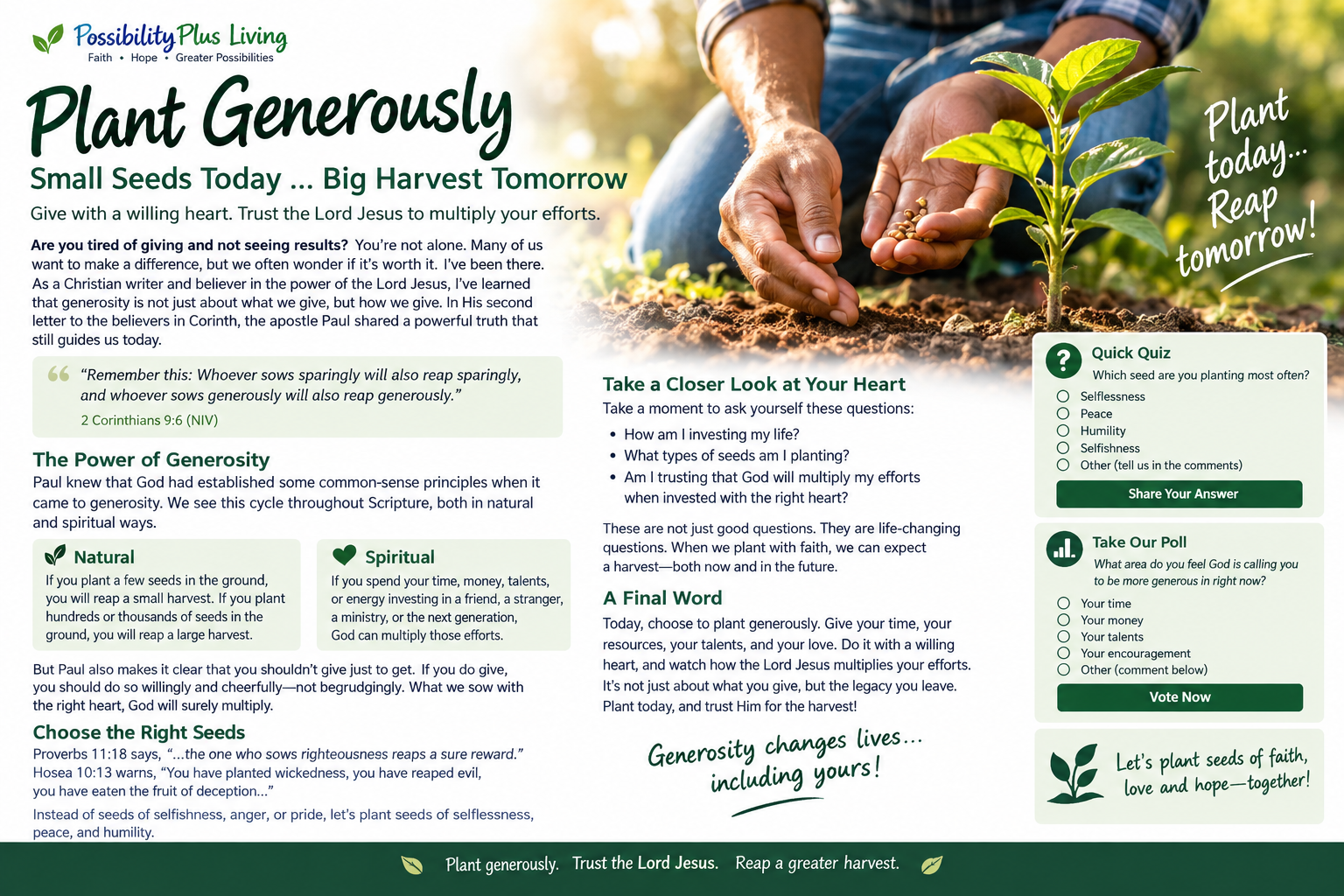
Plant Generously: Small Seeds Today, Big Harvest Tomorrow
Have you ever done something good for someone and wondered whether your efforts made any difference? Perhaps you gave your time to help a friend, encouraged someone who felt discouraged, supported a ministry, or helped a family member in need. Yet, despite your efforts, you saw little change.
Here is an important truth: You may not see the harvest today, but that does not mean your seeds are wasted.
As a Christian writer and believer in the power of the Lord Jesus Christ, I want to encourage you to look at generosity differently. Generosity is not simply about giving money. It is about how you invest your time, talents, love, resources, and energy in the lives of others.
In this article, we will explore what the Bible teaches about sowing and reaping, why our motives matter, and how we can plant seeds of faith, kindness, peace, and humility every day. Most importantly, you will learn how to plant generously without expecting an immediate reward and trust the Lord Jesus Christ with the results.

The apostle Paul shared a powerful lesson about generosity in his second letter to the believers in Corinth. He used the familiar practice of planting seeds to explain a spiritual principle that still applies to our lives today.
In 2 Corinthians 9:6, the NIV says:
“Remember this: Whoever sows sparingly will also reap sparingly, and whoever sows generously will also reap generously.”
This verse reminds us that our actions matter. Just as a farmer plants seeds in expectation of a harvest, we make daily choices that influence the lives of others and shape our own character.
For example, a farmer cannot expect a field full of crops after planting only a few seeds. Likewise, we cannot expect to build strong relationships if we rarely show kindness, offer encouragement, or make time for the people we love.
However, planting generously does not mean giving everything away or expecting the Lord Jesus to make us rich. Paul was teaching the believers to give willingly and cheerfully to meet a genuine need. He was not offering a formula for getting wealthy.
Instead, Christian generosity begins with a willing heart. We give because we love, because we want to help, and because we desire to reflect the character of the Lord Jesus Christ.
Therefore, the question is not simply, “How much am I giving?” It is also, “What kind of person am I becoming through what I give?”
1. Understand the Natural Law of Sowing and Reaping
First, consider how a farmer plants a garden.
A farmer prepares the soil, plants seeds, waters the ground, and waits patiently. Although the farmer cannot force the seeds to grow, the farmer can create conditions that support growth.
Over time, those seeds may produce vegetables, fruit, or grain. The harvest depends on several factors, including the quality of the soil, the weather, and the care the plants receive.
Similarly, our lives produce results through the choices we make repeatedly.
If we plant seeds of anger, dishonesty, and selfishness, we can damage our relationships. If we continually plant seeds of kindness, patience, honesty, and love, we create opportunities for trust and stronger relationships to grow.
Nevertheless, we must remember that people are not plants, and every act of kindness does not guarantee a particular result. Someone may reject our help or fail to appreciate our efforts. Even so, doing what is right remains valuable.
The lesson is simple: We cannot control every harvest, but we can choose which seeds we plant.
So, before you complain about what is missing from your life, take a moment to examine what you are planting today.
2. Plant Spiritual Seeds That Make a Difference
Next, consider how generosity extends beyond money.
The Lord Jesus Christ gives us opportunities to make a difference through ordinary actions. We can plant spiritual seeds in our homes, workplaces, churches, neighborhoods, and communities.
Here are four practical ways to begin.

Plant seeds of encouragement.
When someone feels discouraged, take time to listen. Offer sincere words of hope instead of criticism. A few thoughtful words may help someone find the strength to keep going.

Plant seeds of kindness.
Help a neighbor, visit someone who feels lonely, share a meal, or volunteer in your community. Small acts of kindness can meet real needs and demonstrate Christian love.

Plant seeds in the next generation.
Teach children and young people to value truth, integrity, prayer, compassion, and faithfulness to the Lord Jesus Christ. Your example today may influence their decisions for years to come.

Plant seeds through service.
Use your skills, knowledge, and experience to help someone else. You do not need a large bank account or a public platform to make a difference. You simply need a willing heart.
Furthermore, remember that generosity can take many forms. Sometimes the most valuable thing you can give is your attention. At other times, it may be your practical help, financial support, or willingness to forgive.
Whatever the opportunity, look for ways to use what you have to serve others.
3. Give with the Right Heart
Although generosity matters, our motives matter too.
Paul explained this principle just a few verses after his statement about sowing generously. In 2 Corinthians 9:7, the NIV says:
“Each of you should give what you have decided in your heart to give, not reluctantly or under compulsion, for God loves a cheerful giver.”
The surrounding passage teaches that Christian giving should come from a willing heart rather than pressure or manipulation.
Imagine two people who donate money to the same charity.
The first person gives because they genuinely want to help people in need. The second gives only because they want others to praise them. Although both donations may help the charity, their motives differ.
The first person focuses on meeting a need. The second focuses on receiving recognition.
This example reminds us that generosity is more than an outward action. It also reveals something about our hearts.
Therefore, before you give your time, money, or energy, ask yourself these questions:
-
Am I giving because I genuinely want to help?
-
Am I trying to impress someone?
-
Will I become angry if the person does not thank me?
-
Am I giving freely, or am I acting out of fear and pressure?
-
Can I give responsibly without neglecting my own essential obligations?
These questions can help us develop a healthier understanding of biblical generosity.
Remember: The goal is not to give so that the Lord Jesus owes us a reward. The goal is to give willingly, lovingly, and wisely, trusting Him with the outcome.
4. Choose the Right Seeds: Righteousness Over Selfishness
Next, we must pay attention to the kind of seeds we plant.
Proverbs 11:18 (KJV) says:
“…to him that soweth righteousness shall be a sure reward.”
This verse points us toward a life of integrity and right conduct. We cannot build a life of lasting value by continually choosing dishonesty, selfishness, or pride.
Likewise, Hosea 10:13 (KJV) warns:
“Ye have plowed wickedness, ye have reaped iniquity; ye have eaten the fruit of lies…”
These passages show the serious consequences of our choices. When we repeatedly practice harmful behavior, we may eventually experience the damage it causes.
For example, consider a person who constantly criticizes coworkers. At first, that person may believe the criticism makes them look intelligent or important. Over time, however, coworkers may stop trusting them. Eventually, the person may wonder why others avoid them.
Now consider someone who chooses patience, honesty, and encouragement. That person may not receive immediate recognition. Nevertheless, those choices can help build a reputation for trustworthiness and care.
Therefore, instead of planting seeds of selfishness, anger, jealousy, or pride, let us plant seeds of:
-
Selflessness — putting genuine concern for others into action.
-
Peace — seeking understanding instead of unnecessary conflict.
-
Humility — recognizing that we need the Lord Jesus Christ and can learn from others.
-
Honesty — telling the truth even when dishonesty seems easier.
-
Forgiveness — refusing to let bitterness control our hearts.
-
Love — treating people with compassion, dignity, and respect.
Of course, planting these seeds does not mean tolerating abuse or allowing others to exploit us. We can show love while maintaining healthy boundaries. We can forgive while still seeking justice and accountability.
Ultimately, the seeds we choose should reflect the teachings of the Lord Jesus Christ.
5. Stop Expecting an Immediate Harvest
One of the greatest challenges in Christian living is learning to remain faithful when we cannot see results.
Perhaps you have prayed for a family member for years. Maybe you have tried to encourage someone who continues to make harmful decisions. Or perhaps you have served faithfully in your church or community without receiving recognition.
In such moments, you may wonder, “Is any of this making a difference?”
Consider a farmer who plants a seed on Monday and returns on Tuesday expecting a mature plant. When nothing appears, the farmer could conclude that planting was pointless. However, that conclusion would ignore the time required for growth.
In the same way, meaningful change often takes time.
A child may remember a lesson years after you taught it. A discouraged friend may draw strength from words you spoke long ago. Someone you helped may later choose to help another person.
You may never witness the full effect of your generosity. Even so, you can continue doing what is right.
Galatians 6:9 (KJV) offers this encouragement:
“And let us not be weary in well doing: for in due season we shall reap, if we faint not.”
This scripture encourages us to persevere in doing good rather than giving up because results seem slow.
However, perseverance does not mean repeating every action regardless of its effectiveness. Sometimes wisdom requires us to change our approach, seek advice, or recognize that another person’s choices are beyond our control.
The important lesson is to remain faithful without demanding that every seed produce an immediate or visible reward.
6. Trust the Lord Jesus Christ with the Increase
Now we come to an essential part of planting generously: trusting the Lord Jesus Christ with the outcome.
In 1 Corinthians 3:6–7, Paul uses the image of planting and watering to explain that human effort alone does not produce spiritual growth. One person plants, another waters, but the Lord gives the increase.
This principle helps us maintain the right perspective.
We have responsibilities. We can share the truth, encourage others, serve our communities, give wisely, and live with integrity. Nevertheless, we cannot force another person to believe, change, or respond as we wish.
For example, a parent can teach a child to pray and live by biblical principles. However, that parent cannot make every decision for the child forever. A Christian teacher can explain Scripture clearly, but each listener must respond personally.
Consequently, we must learn to distinguish between our responsibilities and the results we cannot control.
Our responsibility is to plant faithfully. Our responsibility is to water what we have planted. Our responsibility is to act with love and wisdom.
The outcome, however, is not entirely in our hands.
So, when you give, serve, teach, or encourage, do so with faith rather than fear. Do not measure the value of your efforts solely by immediate results. Instead, seek to honor the Lord Jesus Christ through the way you live.
7. Examine What You Are Planting Today
At this point, let us make the message personal.
Imagine that you could look back over the past seven days and examine the seeds you planted. What would you discover?
Perhaps you planted seeds of kindness by helping a neighbor. Perhaps you planted seeds of peace by refusing to respond angrily during a disagreement. Maybe you planted seeds of faith by reading Scripture with your family.
On the other hand, you may recognize moments when you planted seeds of impatience, criticism, or selfishness.
Do not use this exercise to condemn yourself. Instead, use it as an opportunity to grow.
The Lord Jesus Christ offers us the opportunity to repent, learn, and make better choices. We do not have to repeat yesterday’s mistakes simply because they have become familiar habits.
Here are three practical steps you can take today.
Step 1: Examine your heart.
Identify one attitude or habit that needs to change. Ask the Lord Jesus Christ to help you recognize where you need to grow.
Step 2: Choose one good seed.
Decide on one specific act of generosity you can practice today. You might encourage a friend, help someone with a task, or give responsibly to a genuine need.
Step 3: Make generosity a habit.
Look for opportunities to serve each day. Keep practicing kindness and humility, even when nobody notices.
By taking these steps consistently, you can begin to build a life that reflects the love and teachings of the Lord Jesus Christ.
Remember, you do not need to change everything in one day. Begin with one seed, one choice, and one opportunity to do good. Then keep going.
Interactive Quiz: What Kind of Seeds Are You Planting?
Test your understanding of the biblical principle of sowing generously.
Plant Generously Bible Quiz
4 questions · Choose one answer for each
1. According to 2 Corinthians 9:6, what principle did Paul teach?
2. According to 2 Corinthians 9:7, how should we give?
3. What should you do when you cannot see immediate results from doing good?
4. Which is an example of planting a good spiritual seed?
Check My Answers
Reader Poll: Where Can You Plant More Generously?
What is one area where you feel called to be more generous right now?
Reflect on My ChoiceThis is a personal reflection poll. Your selection is not published or sent to a public survey.
A Final Word: Plant Today, Trust the Lord for Tomorrow
Today, you have a choice. You can spend your time focusing only on what you hope to receive, or you can begin investing in the lives of others with a willing and generous heart.
When you plant seeds of kindness, humility, peace, faith, and love, you reflect the character of the Lord Jesus Christ. Although you may not see immediate results, your choices still matter.
Therefore, do not become discouraged when your efforts seem small. A single encouraging word, a quiet act of service, or a generous gift can make a meaningful difference.
At the same time, remember that biblical generosity is not a promise of financial wealth or a guarantee that every person will respond positively. Give wisely, serve faithfully, and trust the Lord Jesus Christ rather than demanding a particular outcome.
So, what will you plant today?
Will you plant seeds of selfishness or selflessness? Anger or peace? Pride or humility? Will you use what you have to bless others?
The choice begins with you.
A Prayer for a Generous Heart
Lord Jesus Christ, please examine my heart and show me what I am planting in my life. Remove selfishness, pride, anger, and every attitude that keeps me from showing genuine love. Teach me to give willingly, serve faithfully, and encourage others without expecting praise or an immediate reward. Help me use my time, talents, resources, and opportunities wisely. When I become discouraged, remind me to continue doing what is right. Direct my steps so that my life will produce good fruit and bring honor to Your name. In Jesus’ name, Amen.
Your personal commitment: I will plant generously. I will give with a willing heart. I will sow seeds of kindness, peace, humility, and love. I will continue doing good, even when I cannot see the harvest. I will trust the Lord Jesus Christ with the results.
If this message encouraged you, share it with someone who needs a reminder that their faithful efforts matter. Together, let us plant seeds that bring hope, strengthen faith, and make a difference in the lives of others.
Subscribe to our YouTube channel for more inspiring biblical encouragement and faith-filled content:
Possibility Plus:
https://www.youtube.com/@PossibilityPluspm
Support our ministry and help us continue sharing hope, truth, and the message of the lord Jesus Christ:
https://printify.com/app/store/products/1
Get your copy of Deceived No More: Wolves in Sheep’s Clothing by Paul Edwards:
https://www.amazon.com/Deceived-No-More-Wolves-Clothing/dp/B0FVFFVYYB
Keep walking. Keep trusting. keep in step with the Spirit.